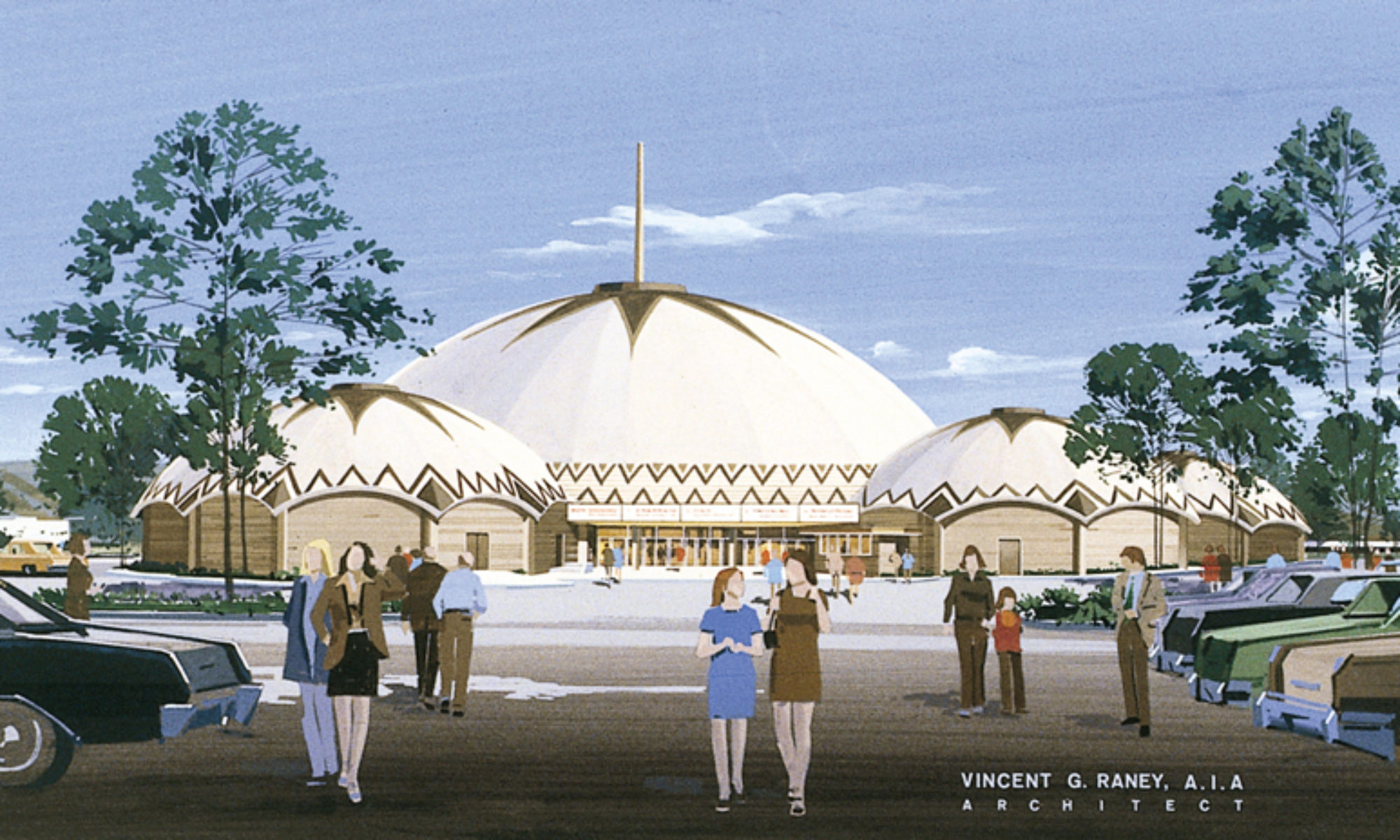
When I was only 14 years old I watched an advance screening of Blade Runner at the Utah Theatre in Salt Lake City, Utah. All we knew before arriving for our 8 PM showing on 20 May 1982 was that the film was science fiction and starred Harrison Ford. We had no idea the movie we were about to see would only receive an R rating after some of the violence was trimmed.
My two older sisters and I were major fans of Star Wars and Raiders of the Lost Ark. We quoted Star Wars and had long discussions about why Darth Vader couldn’t possibly be Luke’s father. Halfway into Raiders‘ year-long run at the Villa Theatre, I recorded in my journal that I had seen the film 14 times.
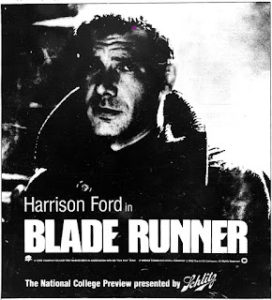
While taking a class at the University of Utah, one of my sisters noticed an advertisement for Blade Runner in the school newspaper. The Monday ad only mentioned that it was part of “The National College Preview by Schlitz.”
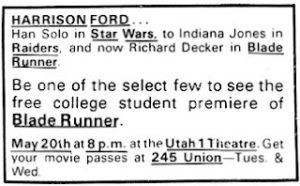
Text ads on Tuesday and Wednesday read, “Harrison Ford… Han Solo in Star Wars, to Indiana Jones in Raiders, and now Richard Decker in Blade Runner. Be one of the select few to see the free college student premiere of Blade Runner. May 20th at 8 p.m. at the Utah 1 Theatre. Get your movie passes at 245 Union – Tues. & Wed.”
How could we NOT want to see this move? My sister hurried over to the ASUU on her lunch break and picked up four free tickets.
Our mother wasn’t a big fan like us, but she came with us to the showing. We sat in the middle of the front row, with our knees practically touching the stage. Intermountain Theatres divided the Utah Theatre horizontally in 1968. Our screening was in the lower auditorium, with draperies and a suspended ceiling hiding scarred remains of the once ornate movie palace.
I loved Blade Runner and couldn’t wait to see it again. My oldest sister said “no way” and my mother was embarrassed she brought her young children to such a violent film. She was convinced the exiting moviegoers must be looking at her and thinking about what a bad parent she was.
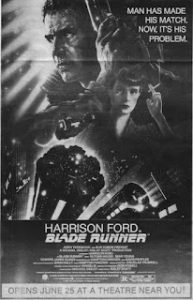
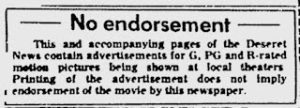
This was Utah in 1982. The Deseret News had just ended a 10-year ban on advertising R-rated movies, but still felt it necessary to include the disclaimer, “- No endorsement – This and accompanying pages of the Deseret News contain advertisements for G, PG, and R-rated motion pictures being shown at local theaters. Printing of the advertisement does not imply endorsement of the movie by this newspaper.”
We did see Blade Runner again, on network television. I remember the rotating shot of Deckard and Gaff descending in a spinner to a building with a circular roof.

This scene had been spectacular at the Utah Theatre, but just wasn’t the same on the small screen. I don’t know what else was on television that night, but we hopped channels and only watched parts of Blade Runner. I lost my enthusiasm for the film and mostly forgot about it over the years.
The 70mm Workprint
After learning of the workprint, I became convinced it was the version I experienced at the Utah Theatre so many years ago. The only known showings, however, were March 5 at the Continental in Denver and March 6 at the Northpark in Dallas.
How could I prove the workprint showed at the Utah Theatre as well?
Timing
Four known versions of Blade Runner played in movie theaters in 1982:
- 70mm workprint (5 & 6 March 1982)
- San Diego test screening (8 May 1982)
- US theatrical release (25 June 1982)
- International theatrical release
Thinking the date might provide the answer, I spent quite a bit of time searching old newspaper advertisements for a missing evening showtime at the Utah Theatre. When this yielded no results, I quizzed my sister. She remembered seeing something about Blade Runner and Harrison Ford in the University of Utah Chronicle. I made two trips to the Marriott Library and searched a roll of microfilm containing six months of the school newspaper.
I started in late February and very carefully examined each page. By the end of March, I picked up the pace. After passing May 8, I began to despair. The San Diego screening had taken place and we were approaching the June 25 release. I started to breeze through, fearing I had missed a small text announcement somewhere back in April. Then a photo of Harrison Ford filled the entire screen. Our date was May 20.
Content
I did not want to have seen the San Diego version, with its happy ending and much-maligned narration. Without the date on my side, I had to turn to differences in content. Long lists have been published about the differences in Blade Runner version. I poured over these and compared them with my memories.
Memory plays funny tricks, especially after thirty years. While researching Utah movie theaters, I’ve talked with people who thought they saw a movie in one theater when I have newspaper ads proving it played elsewhere.
I checked Blade Runner: The Final Cut out of the library and watched it with ClearPlay filtering. Some scenes I don’t want to see again, like Batty placing his hands on both sides of Tyrell’s head and squeezing until you hear bone crushing.
A lot of the film had slipped from my memory. For example, the scene with Leon and Holden at the beginning seemed entirely new to me. I even confused Holden with Deckard, thinking Harrison Ford really looked young. I remembered other parts of the film more clearly, like Pris doing backflips toward Deckard as she attacks.
Three sets of details are non-negotiable. I’m absolutely certain of their accuracy.
- Our screening had a very definite ending, but no end credits. The screen was completely blank. At first we thought the film broke, but the exit music played and film ran through the projector.
- I remember the two dancers in hockey masks outside Taffy Lewis’s club.
- We saw the extended scenes of violence that were trimmed after the San Diego preview.
Was it 70mm?
One of my sisters went to the back of the auditorium to peer through the projector window. For some reason we thought the film might be playing in 70mm. I don’t know how we got that idea, other than the picture was bright and the sound impressive. I’m not sure what our conclusion was at the time and neither of my sisters remembers this.
The Utah Theatre presented at least four movies in 70mm during the late 1960s, but never advertised any during the 1980s. Crossroads Cinemas opened in 1980, booking any downtown 70mm engagements that slipped past the grand Centre Theatre. If still equipped in 1982, the Utah would have been the least expensive 70mm theater to rent in the Salt Lake area.
False Memories
Until reading this article, I thought I had seen the happy ending at the end of the network television broadcast. I remember a single, high-angled shot of Deckard and Rachel walking away from the camera, hand in hand, into a garden paradise on the roof of the building. The ambiguous ending was so impossible that it called into question the reality of the entire movie proceeding it.
The actual ending shows the pair driving on a country road, with cheesy narration about how Rachel has no expiration date. The scene made me cringe. I can’t possibly imagine ever seeing it before in my life. Had it appeared at the end of our 20 May 1982 screening, I think I would have disowned the movie. It goes completely against the tone of the rest of the film.
I asked one of my sisters about the ending, without leading any leading questions. She had only seen the movie once in its entirety, at our preview screening, but had seen bits and pieces over the years while flipping channels. She remembered Rachel and Deckard in a car with narration from Deckard. Then she thought the car should be flying.
That rang a bell. My happy ending expanded to include a car in the center of the roof. Deckard and Rachel get in and a second shot shows the car rising and flying off (literally) into the sunrise (it was morning, not evening.)
My other sister has seen different versions of the film over the years. She remembered Deckard and Rachel getting into a truck and riding into the sunset. The sun does almost make an appearance in the country drive happy ending, but they “drive into the sunset” only in the figurative sense.
The more I analyze this, the more convinced I am that my imagination concocted the whole rooftop happy ending. My strongest memory is reading an article (close to 1982) that criticized the addition of the happy ending to the film. Not a newspaper article, but maybe an entertainment magazine. It mentioned something about Deckard and Rachel hand in hand, stepping over that short wall at the edge of the building roof and into a fantasy garden that couldn’t possibly exist. If this memory is true, the article probably spoke figuratively and I mistook it for literal. My mind filled in the blanks.
Or I’m simply confusing Blade Runner with a rooftop scene from some other movie. (No good candidates come to mind.)
For decades that’s how I believed Blade Runner ended: Deckard and Rachel in an impossible rooftop garden.
Which means our 20 May 1982 screening had no happy ending. My imagination couldn’t have concocted my own ending so soon after seeing the actual country drive.
Conclusions
I feel like someone has been tampering with my memories. I’ve spent long hours over several weeks trying to prove what I thought was always part of my life. In the end, I can never be certain which memories are genuine and which have been tainted by my own preference for a particular answer.
Did the 70mm workprint play at the Utah Theatre in 1982? We’ll never know.
Best theories:
- After the May 8 San Diego test screening, the investors who funded the film decided to launch a nationwide college preview to generate word-of-mouth for the June 25 release. With final prints not yet available, they used all prints on hand, even if they weren’t the most current version. The March 5 workprint came to the Utah because theater was cheap to rent and still equipped for 70mm.
- The San Diego print played at the Utah Theatre. Information on this version is sketchy, meaning we may be relying on someone’s memory of what the differences were. I don’t know if any copy of the print still exists. It may have included the two hockey dancers and lacked end credits. I may have forgotten the narration and happy ending.
- We saw an intermediary cut of the film, somewhere between the March workprint and the May San Diego test. Maybe there was a rooftop happy ending after all.
- I’m really a replicant and was never in the Utah Theatre to start with.
“Blade Runner: The Original 70mm Engagements”, in70mm.com, retrieved January 2016
“Blade Runner (1982), Alternate Versions”, imdb.com, retrieved January 2016
“Versions of Blade Runner”, wikipedia.org, retrieved January 2016