Utah Theatre Lobby Panorama

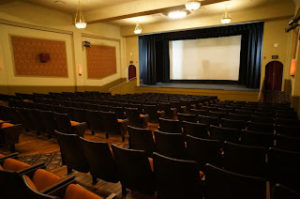
Three times during the summer of 2012, the Utah Heritage Foundation offered free tours of the old Utah Theatre in Salt Lake City.  I remember coming here to see The Secret of NIHM in 1982.  I was amazed at the detail in the ceiling of the upstairs auditorium.  And who can forget that long hallway from Main Street back to the lobby?

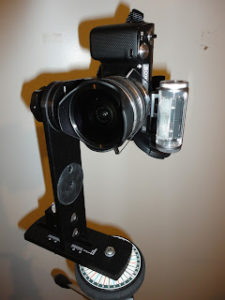
When I came to the tour on 11 August 2012, I brought my fisheye lens with me in hopes of making a panorama like I’ve done of other theaters, like the Villa.  To make a panorama, I have to mount my camera to a tripod, level it, set the white balance, set the exposure, then take a few photos without moving the focal point of the lens.  I usually make arrangements to get into the building when no one else is using it, so I don’t have to deal with people walking in and out of the shot.

Other than setting the white balance, none of these options were available to me at the Utah Theatre.  I was supposed to be part of a tour group of about ten people and we had to stay together.  Using a tripod was not an option and I would have felt too conspicuous carrying one around.  I did the tour, took what regular pictures I could, then left and visited a couple other downtown sites.

When I returned to the Utah Theatre, the crowd had died down and things were more relaxed.  A couple other photographers were wandering around on their own, so I got to work.  I put the fisheye on and tried to keep the lens in the same position as I swiveled the camera around to complete a circle of photos.  The lighting was poor, so I had to use the flash.  Inconsistent lighting is another thing which can doom a panorama.

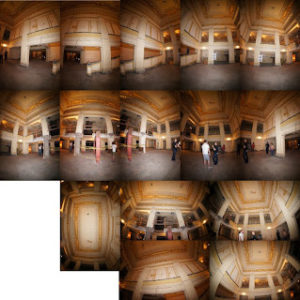
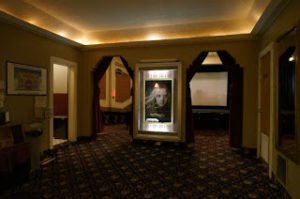
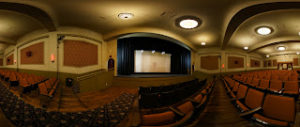
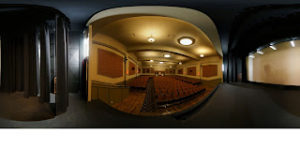
I took panorama photos in eight locations.  When I made it to the lobby, I had a problem.  A couple people were standing in the way.  Since I had doubts about any of it working anyway, I just ignored them and took my photos anyway.  For the lobby, I ended up with fifteen shots:

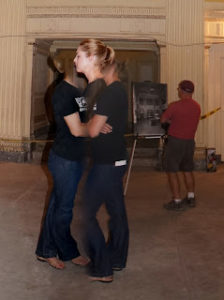
Surprisingly, these blended together fairly well.  I upgraded to PTGui Pro, which helped with the lack of tripod and the uneven lighting.  I was stuck on the two people standing nearby.  The woman appeared in three different spots, but the man she was talking to managed to move out of the way.

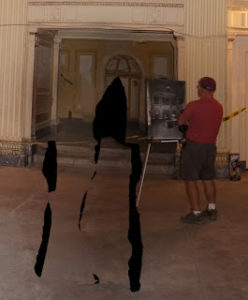
After some fine tuning to the masking, I managed to remove the woman and replace her with alternate images from the other shots, but that left large gaps and some lines in the background that just didn’t line up.

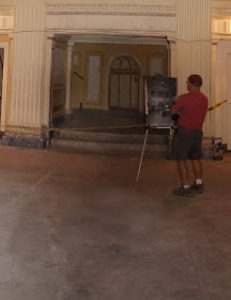
The clone tool in GIMP was my only option.  By copying nearby portions of the image, I was able to patch things up.  If you don’t look too closely.

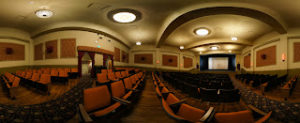
The finished panorama:

I’m surprised, but very pleased, that the panorama turned out.  Still I would love to return with a tripod, no crowds, and permission to cross the yellow caution tape.

Casino Star Theatre

The Casino Star Theatre in Gunnison, Utah turned 100 years old on 13 January  2013.  This may be the best-preserved small-town theater in Utah, and they’re still showing movies.  The lobby and auditorium are just beautiful and the façade has been mostly restored.

Auditorium of the Casino Star Theatre
Lobby of the Casino Star Theatre

On 19 January 2013, I spent three hours touring the Casino Star.  Diana Spencer, with the Casino Star Theatre Foundation, took me from the basement to the upstairs rooms, explaining the theater’s history and showing me some of its relics from days gone by.

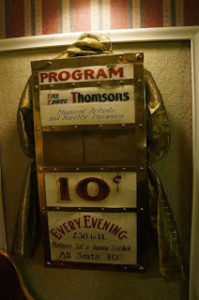
A restored attraction board, now on display in the lobby.
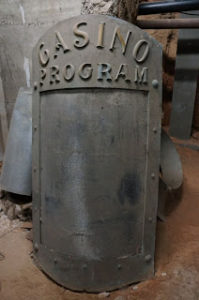
An old poster case, stored in the basement under the auditorium.

During my three hours in the theater, I took five panoramas and 237 photos.  I spent 15 hours over the next week sorting through the photos and selecting those to use on my utahtheaters.info web site.  I added 14 photo pages to accommodate them.  As is typical on these photos trips, once I got home and started looking over the photos, I found things that I could have done better.  I will have to go back.

These are the first panoramas I’ve made with my new Panosaurus panorama head.

This piece of equipment keeps the focal point of my fisheye lens over the exact center of my tripod as I take the several photos that later get blended together to form the panorama.  With my old camera, a Nikon Coolpix 4500, I built my own panorama head using inexpensive parts from the hardware store.  I spent several hours on each panorama, manually blending the images together so the seams would not be visible.  With the new panorama head, camera (a Sony Nex-5N), and PTGui Pro panorama software, I was able to complete my five panoramas of the Casino Star in just three hours.

Panorama of the Foyer
Panorama of the Lobby
Panorama of the Auditorium
Panorama on the Stage

See all the photos of the Casino Star Theatre.

“Blade Runner” Workprint at the Utah Theatre

When I was only 14 years old I watched an advance screening of Blade Runner at the Utah Theatre in Salt Lake City, Utah.  All we knew before arriving for our 8 PM showing on 20 May 1982 was that the film was science fiction and starred Harrison Ford.  We had no idea the movie we were about to see would only receive an R rating after some of the violence was trimmed.

My two older sisters and I were major fans of Star Wars and Raiders of the Lost Ark.  We quoted Star Wars and had long discussions about why Darth Vader couldn’t possibly be Luke’s father.  Halfway into Raiders‘ year-long run at the Villa Theatre, I recorded in my journal that I had seen the film 14 times.

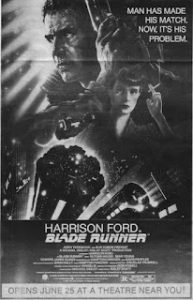
While taking a class at the University of Utah, one of my sisters noticed an advertisement for Blade Runner in the school newspaper.  The Monday ad only mentioned that it was part of  “The National College Preview by Schlitz.”
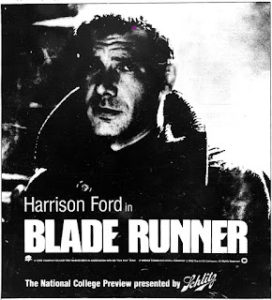
Blade Runner advertisement for the National College Preview by Schlitz.

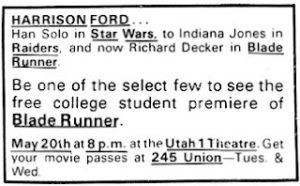
Text ads on Tuesday and Wednesday read, “Harrison Ford…  Han Solo in Star Wars, to Indiana Jones in Raiders, and now Richard Decker in Blade Runner.  Be one of the select few to see the free college student premiere of Blade Runner.  May 20th at 8 p.m. at the Utah 1 Theatre.  Get your movie passes at 245 Union – Tues. & Wed.”

How could we NOT want to see this move?  My sister hurried over to the ASUU on her lunch break and picked up four free tickets.

Our mother wasn’t a big fan like us, but she came with us to the showing.  We sat in the middle of the front row, with our knees practically touching the stage.  Intermountain Theatres divided the Utah Theatre horizontally in 1968.  Our screening was in the lower auditorium, with draperies and a suspended ceiling hiding scarred remains of the once ornate movie palace.

I loved Blade Runner and couldn’t wait to see it again.  My oldest sister said “no way” and my mother was embarrassed she brought her young children to such a violent film.  She was convinced the exiting moviegoers must be looking at her and thinking about what a bad parent she was.

My argument that the film wasn’t that violent quickly died as specific instances of skull crushing, eye gouging, and finger breaking were brought up.  We had a long wait until the first ad showed up for the June 25 release, revealing that the movie indeed carried a R rating, which ended any question of seeing it again.
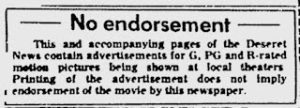
This was Utah in 1982.  The Deseret News had just ended a 10-year ban on advertising R-rated movies, but still felt it necessary to include the disclaimer, “- No endorsement –  This and accompanying pages of the Deseret News contain advertisements for G, PG, and R-rated motion pictures being shown at local theaters.  Printing of the advertisement does not imply endorsement of the movie by this newspaper.”

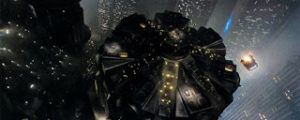
We did see Blade Runner again, on network television.  I remember the rotating shot of Deckard and Gaff descending in a spinner to a building with a circular roof.

This scene had been spectacular at the Utah Theatre, but just wasn’t the same on the small screen.  I don’t know what else was on television that night, but we hopped channels and only watched parts of Blade Runner.  I lost my enthusiasm for the film and mostly forgot about it over the years.

The 70mm Workprint

While recently researching 70mm performances in the Salt Lake area, I came across some intriguing information.  A 70mm workprint of Blade Runner showed at test screenings in March 1982.  Negative reaction from audiences led to the addition of voice-over narration and a happy ending.
Preservationists discovered a 70mm copy of Blade Runner in the Todd-AO vaults and the print screened at a May 1990 film festival at the Cineplex Odeon Fairfax in Los Angeles.  Attendees soon realized they were watching the workprint rather than released version of the film.  Popularity of workprint screenings led to a “Director’s Cut” in 1992 and “The Final Cut” in 2007.
After learning of the workprint, I became convinced it was the version I experienced at the Utah Theatre so many years ago.  The only known showings, however, were March 5 at the Continental in Denver and March 6 at the Northpark in Dallas.

How could I prove the workprint showed at the Utah Theatre as well?

Timing

Four known versions of Blade Runner played in movie theaters in 1982:

  • 70mm workprint (5 & 6 March 1982)
  • San Diego test screening (8 May 1982)
  • US theatrical release (25 June 1982)
  • International theatrical release

Thinking the date might provide the answer, I spent quite a bit of time searching old newspaper advertisements for a missing evening showtime at the Utah Theatre.  When this yielded no results, I quizzed my sister.  She remembered seeing something about Blade Runner and Harrison Ford in the University of Utah Chronicle.  I made two trips to the Marriott Library and searched a roll of microfilm containing six months of the school newspaper.

I started in late February and very carefully examined each page.  By the end of March, I picked up the pace.  After passing May 8, I began to despair.   The San Diego screening had taken place and we were approaching the June 25 release.  I started to breeze through, fearing I had missed a small text announcement somewhere back in April.  Then a photo of Harrison Ford filled the entire screen.  Our date was May 20.

Content

I did not want to have seen the San Diego version, with its happy ending and much-maligned narration.  Without the date on my side, I had to turn to differences in content.  Long lists have been published about the differences in Blade Runner version.  I poured over these and compared them with my memories.

Memory plays funny tricks, especially after thirty years.  While researching Utah movie theaters, I’ve talked with people who thought they saw a movie in one theater when I have newspaper ads proving it played elsewhere.

I checked Blade Runner: The Final Cut out of the library and watched it with ClearPlay filtering.  Some scenes I don’t want to see again, like Batty placing his hands on both sides of Tyrell’s head and squeezing until you hear bone crushing.

A lot of the film had slipped from my memory.  For example, the scene with Leon and Holden at the beginning seemed entirely new to me.  I even confused Holden with Deckard, thinking Harrison Ford really looked young.  I remembered other parts of the film more clearly, like Pris doing backflips toward Deckard as she attacks.

Three sets of details are non-negotiable.  I’m absolutely certain of their accuracy.

  • Our screening had a very definite ending, but no end credits.  The screen was completely blank.  At first we thought the film broke, but the exit music played and film ran through the projector.
  • I remember the two dancers in hockey masks outside Taffy Lewis’s club.
  • We saw the extended scenes of violence that were trimmed after the San Diego preview.
If all the information about version differences is accurate, then these three items prove we saw the workprint.

Was it 70mm?

One of my sisters went to the back of the auditorium to peer through the projector window.  For some reason we thought the film might be playing in 70mm.  I don’t know how we got that idea, other than the picture was bright and the sound impressive.  I’m not sure what our conclusion was at the time and neither of my sisters remembers this.

The Utah Theatre presented at least four movies in 70mm during the late 1960s, but never advertised any during the 1980s.  Crossroads Cinemas opened in 1980, booking any downtown 70mm engagements that slipped past the grand Centre Theatre.  If still equipped in 1982, the Utah would have been the least expensive 70mm theater to rent in the Salt Lake area.

False Memories

Google Now recently brought my attention to an article detailing how Ridley Scott borrowed footage from The Shinning to make the “happy ending” for Blade Runner.  As I read, I wondered how moving aerial footage could have been used in the stationary matte painting shot I remembered.  At the end of the article was a clip of the US Theatrical ending and it wasn’t even close to what I thought I remembered.

Until reading this article, I thought I had seen the happy ending at the end of the network television broadcast.  I remember a single, high-angled shot of Deckard and Rachel walking away from the camera, hand in hand, into a garden paradise on the roof of the building.  The ambiguous ending was so impossible that it called into question the reality of the entire movie proceeding it.

The actual ending shows the pair driving on a country road, with cheesy narration about how Rachel has no expiration date.  The scene made me cringe.  I can’t possibly imagine ever seeing it before in my life.  Had it appeared at the end of our 20 May 1982 screening, I think I would have disowned the movie.  It goes completely against the tone of the rest of the film.

I asked one of my sisters about the ending, without leading any leading questions.  She had only seen the movie once in its entirety, at our preview screening, but had seen bits and pieces over the years while flipping channels.  She remembered Rachel and Deckard in a car with narration from Deckard.  Then she thought the car should be flying.

That rang a bell.  My happy ending expanded to include a car in the center of the roof.  Deckard and Rachel get in and a second shot shows the car rising and flying off (literally) into the sunrise (it was morning, not evening.)

My other sister has seen different versions of the film over the years.  She remembered Deckard and Rachel getting into a truck and riding into the sunset.  The sun does almost make an appearance in the country drive happy ending, but they “drive into the sunset” only in the figurative sense.

The more I analyze this, the more convinced I am that my imagination concocted the whole rooftop happy ending.  My strongest memory is reading an article (close to 1982) that criticized the addition of the happy ending to the film.  Not a newspaper article, but maybe an entertainment magazine.  It mentioned something about Deckard and Rachel hand in hand, stepping over that short wall at the edge of the building roof and into a fantasy garden that couldn’t possibly exist.  If this memory is true, the article probably spoke figuratively and I mistook it for literal.  My mind filled in the blanks.

Or I’m simply confusing Blade Runner with a rooftop scene from some other movie.  (No good candidates come to mind.)

For decades that’s how I believed Blade Runner ended:  Deckard and Rachel in an impossible rooftop garden.

Which means our 20 May 1982 screening had no happy ending.  My imagination couldn’t have concocted my own ending so soon after seeing the actual country drive.

Conclusions

I feel like someone has been tampering with  my memories.  I’ve spent long hours over several weeks trying to prove what I thought was always part of my life.  In the end, I can never be certain which memories are genuine and which have been tainted by my own preference for a particular answer.

Did the 70mm workprint play at the Utah Theatre in 1982?  We’ll never know.

Best theories:

  • After the May 8 San Diego test screening, the investors who funded the film decided to launch a nationwide college preview to generate word-of-mouth for the June 25 release.  With final prints not yet available, they used all prints on hand, even if they weren’t the most current version.  The March 5 workprint came to the Utah because theater was cheap to rent and still equipped for 70mm.
  • The San Diego print played at the Utah Theatre.  Information on this version is sketchy, meaning we may be relying on someone’s memory of what the differences were.  I don’t know if any copy of the print still exists.  It may have included the two hockey dancers and lacked end credits.  I may have forgotten the narration and happy ending.
  • We saw an intermediary cut of the film, somewhere between the March workprint and the May San Diego test.  Maybe there was a rooftop happy ending after all.
  • I’m really a replicant and was never in the Utah Theatre to start with.
Sources:
“Blade Runner: The Original 70mm Engagements”, in70mm.com, retrieved January 2016
“Blade Runner (1982), Alternate Versions”, imdb.com, retrieved January 2016
“Versions of Blade Runner”, wikipedia.org, retrieved January 2016

Home Practice Organ

Many readers have asked about my practice organ, where I labor every day in hopes of avoiding terrible mistakes on Sunday.  For the last couple years, music had been a huge distraction from my writing, so it’s reasonable to assume I have a seriously impressive practice organ enticing me away from my word processor.

Do I practice in an ancient cathedral with vaulted ceilings, sitting at a six-manual console with rows upon rows of stops to select from the thousands of ranks of pipes that compose this massive and majestic musical instrument?

Okay, so I don’t actually have any readers.  But if I did, this question would be at the top of their list.

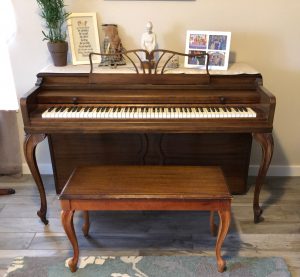
Brief background info:  My piano teacher dropped me as a student because I wasn’t practicing.  A couple of decades later, I started teaching myself to play – using the Gulbrandsen upright piano in our living room.

I’m a prodigy, right?  As soon as my fingers touched the ivory keys, beautiful music soared through the house.

Not exactly.

One evening my wife came downstairs and pleaded, “Can you please stop?  You’re really stressing me out.”

My youngest son objected without words.  Twice.  He simply closed the lid on the piano and walked away.

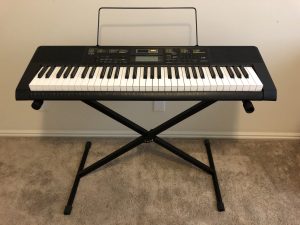
So I bought a Casio CTK-3500 61-key Keyboard.

With Samson HP30 headphones!

The headphones were a real game changer.  Now I could practice for hours on end without annoying anyone in the house.

For a long time, this setup worked really well.  What changed?

I started playing organ pedals.

Driving to the church every day to practice really puts a damper on things.

After watching the KSL Classifieds for a few months, I finally gave up on finding an organ console with a full 32 AGO (American Guild of Organists) pedalboard.  Putting an organ in our family room was out of the question, so my only option was a basement room.

A traditional wooden console would have been too wide.  I could have temporarily removed a couple door frames (not just the doors,) but the deal breaker was the sharp turn at the top of the stairs.  I didn’t want to temporarily remove walls.

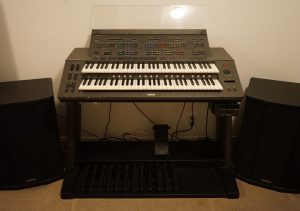
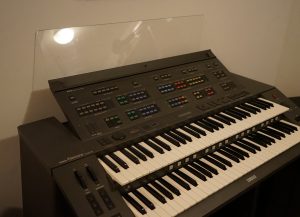
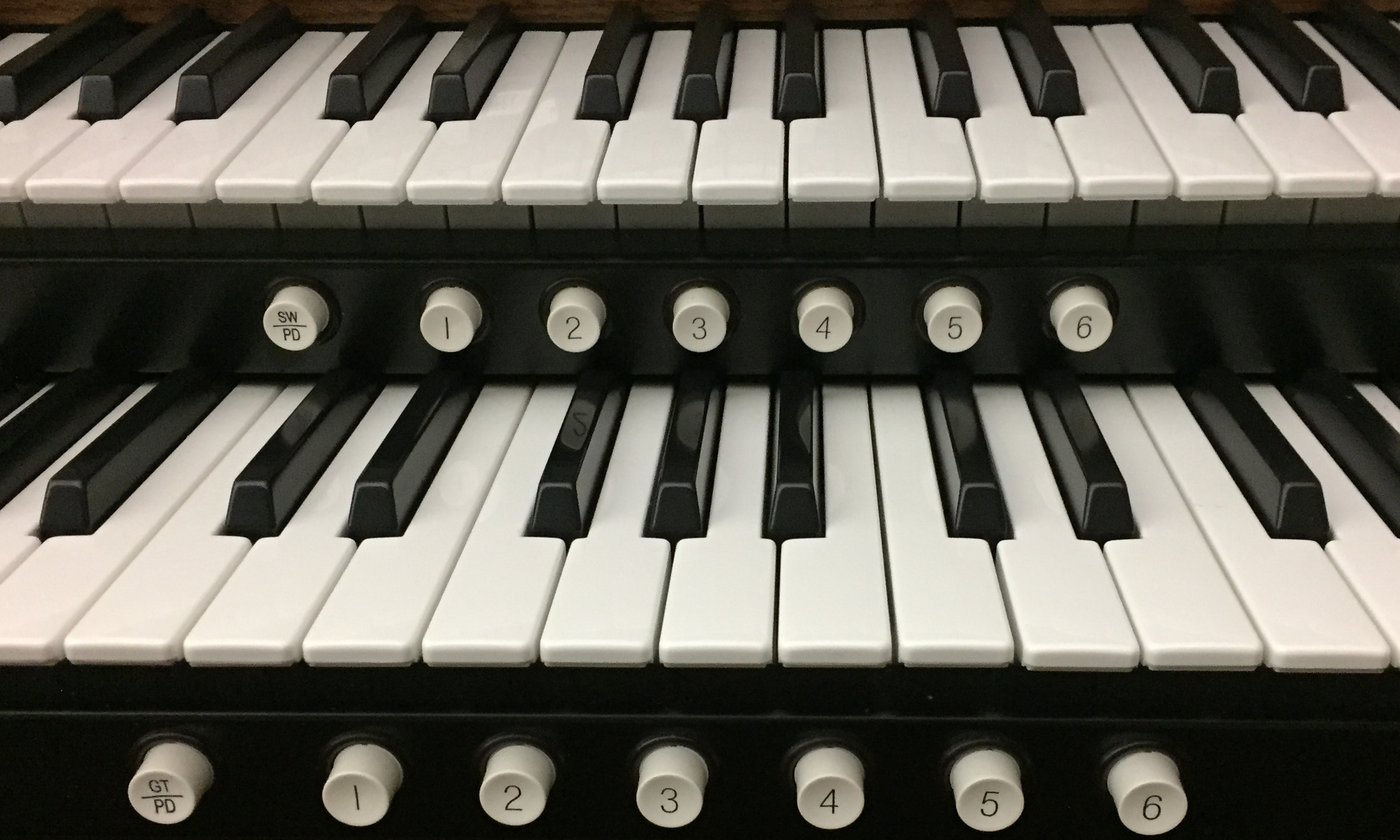
Eventually I found a keeper:  a Yamaha Electone HX-3.

Its key features are dual manuals, MIDI in/out, a headphone jack, and a modular design that helped get it through the door.

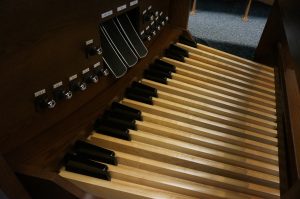
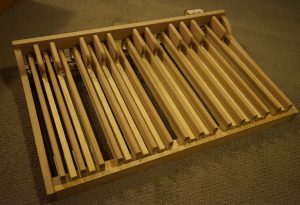
The stubby toe pedals that came with it were too short for real pedal practicing, so I bought a 27-note pedalboard from PedaMidiKit in Italy.

It’s flat and straight instead of concave and radiating, which means I identify as European when I practice at home.  It takes only a little adjustment when I get back on the full 32-note AGO pedalboard at the church.

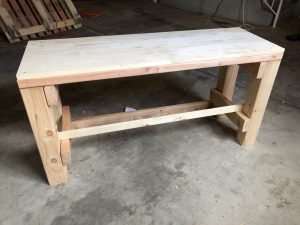
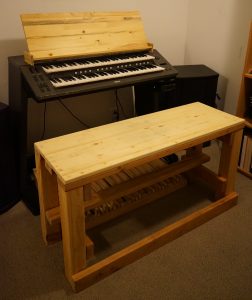
The padded, adjustable bench that came with the Electone did not work with my new pedalboard, so I built my own.  It’s heavy and a bear to move, but – and this is key – it’s wide enough to fit over the pedalboard.

The music stand on the Electone HX-3 is set back quite a ways.

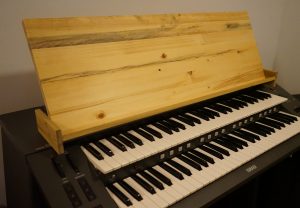
To get my music to where I can focus on it with my over-50 eyes, I built my own.

When you put it all together, it’s a strange mixture of wood and modern plastic.

So that’s my practice organ.  No cathedral?  Well . . .

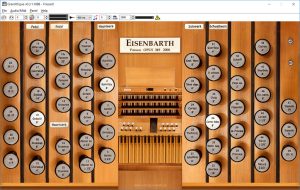
Piotr Grabowski recorded, individually, each and every pipe in the organ at the St. Bartholomäus church in Friesach, Austria.  The MIDI port on my Electone HX connects to GrandOrgue, virtual organ software running on my laptop, which recreates (over Apple EarPods) the Friesach organ in my very own basement!

So, yes, I practice every day in a cathedral with vaulted ceilings.

The Permanency of Death

[This article includes spoilers for movies and TV programs you may have already seen.]

I’m not a huge Marvel fan, but I think I’ve seen all the movies except Ant-Man.  Before going to Avengers: Infinity War, I saw a headline for an article speculating on what major character would die in the film.  I didn’t read the article, but when Loki died at the beginning of the film, I thought, “Oh, so it was him.  Again.”

Mid-way into the film, I changed my mind.  “Oh, so it was her!”  But then, at the very end of the film, I thought, “Are they crazy?”  You’ve seen the film, so you know what I mean.

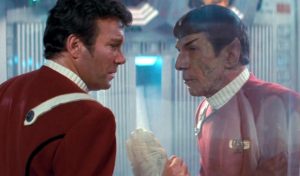
Flash back to 1982, when I was 15 years old.  Back in these days, science fiction and fantasy didn’t fare so well.  I grew up on Star Trek reruns and there wasn’t much else in the way of science fiction on TV.  Enter Star Trek II: the Wrath of Khan.  Rumor had it that Spock would die in the film.

We were not happy.

Our nickname for the first film was, Star Trek: the Motionless Picture, because parts of it were so incredibly boring.  I’m not sure what my expectations were for the second film, but I remember the thrill that came with the opening credit music and that moving starfield in the background.  The movie was phenomenal.

And, yes, Spock died.

But it was one of the best deaths I’ve seen in a science fiction movie.  The entire movie was geared for it.  Spock’s death was foreshadowed from the beginning and reinforced with a theme of beating the no-win scenario.

Then rumor claimed Spock would be brought back to life in the third film.

I’ve alway thought this was a mistake.  Even though I didn’t want Spock to die in the first place, his glorious death was undone by a so-so sequel.  Sure, it was fun have Spock around in Star Trek IV: The Voyage Home and Star Trek VI: The Undiscovered Country, but sometimes I wonder how much better Star Trek II would have been if they’d let his death stand.

So what happens if some insane movie makers decide to kill off half the characters in a huge superhero movie mashup (including characters who have new films slated for release in the next year or so)?  After the initial shock wore off, I thought to myself, “Alternate timeline.”  Doctor Strange saw only one timeline where they won.  Well, this wasn’t it.

How many times have we seen seen the Master die in Doctor Who?  Or Davros?  Sometimes these “dead” characters are brought back to life with no explanation at all.  Even the other characters in the series are unsurprised by their return.

And if Marvel doesn’t bring half their characters back to life in the next Avengers movie, all they have to do is reboot.  Spiderman was rebooted twice in a nine year period.  They didn’t even let the second Spiderman trilogy finish before they rebooted for the third.

Death is a temporary state in fiction.

Wild Success of “A Quiet Place” Post

In last week’s blog I provided some possible plotlines for sequels to A Quiet Place.  You’re probably wondering how soon these exciting story ideas will be brought to the big screen.  Surely a blog post by a wildly successful author like me would eventually attract the attention of the film’s director, John Krasinski.

So here’s how things went.

Fantasy Version

While sitting at my desk at work, my cell phone rang with an out-of-state number and no name.  Typically I assume these are telemarketers and ignore the calls. If it’s important, they’ll leave a voice mail message, right?   But this time, feeling guilty for all the other long-distance calls I’ve neglected, I grab my phone and swipe to answer.

“Information Systems Help Desk.”  I’m at work, so my standard greeting slips out even though it’s a call on my personal number.

“Uh,” the man on the other end says hesitantly.  “Is this Grant Smith?”

I realize my mistake, but it’s starting to sound like a telemarketer already, so I keep going at it.  “Yes, do you need help resetting your password?” Although we’re past the deadline for filing your tax return, that doesn’t stop the procrastinators from making their yearly password reset call.  W2s are only available online.

“Ah, no.  I was actually calling about your blog post.”

Now’s it my turn to sound confused.

“Uh, which blog post?”  I write some technical how-to documents at work, but we refer to those as “Help Documents.”  They can’t be considered blog posts because they aren’t posted on a weekly schedule and don’t allow comments.

“You know, the one on A Quiet Place.”  He laughs.  “I really liked your sequel ideas.  Where do you come up with those?”

I glance around the cubicle farm where I sit, wondering if any coworker could be playing a practical joke on me.  Someone actually read my blog? What are the chances of that? And they actually called me?  Although my phone number is listed in the DNS registry somewhere . . .

Oh, yes.  He asked a question.  Well, I actually was sitting at my keyboard when I typed up those story ideas, sir.  That’s probably not what he wants to hear, though.

“Well, actually, sir, if you tune into my blog next week I’ll be discussing exactly that.”

Already details start to pour in. I was river rafting in India, typing away at my laptop keyboard, when our guide shouted in a panic.  We were headed straight for a waterfall!

The caller is talking, though.  Something about meeting for lunch.

“Wait.  Lunch? Where?”

“L. A?”

L. A.

La.

La Frontera?  It’s on my bus route home.

“Excuse me.”  I press the phone against my ear, determined to pay strict attention from here out.  “What did you say your name was?”

“John.  John Krasinski.”

I’m certain I don’t know anyone with the last name Krasinski.  

“You know,” he goes on.  “I played Lee Abbott in the film, A Quiet Place.  I’m also the director.”

The film.  I know the characters had actual names because I looked up the daughter’s, although I can’t remember even that now.

“Wait.  You’re the John Krasinski?”

He laughs.  “That’s me. So, I can fly you in, but it has to be sometime in the next two days.  I wasn’t planning on doing any sequels, but, hey, I really liked your ideas. We’re even looking at the cruise ship spin-off.”

Now I’m out of my chair, walking around the department to see who’s hunched over their phone trying not to be overheard while making a prank call.

“Just a moment,” the caller says.  After a brief pause he comes back. “I gotta hand the phone over to J. J. Abrams.  He’s having a terrible time with Episode IX and maybe you can help straighten things out . . .”

Realty

The following graph shows all of the visits to my grantedthat.com website for the last week or so.

As you can see, my all-time total visits is only eight, and I’m pretty sure those were all me.  And that’s for the entire site, not just last week’s blog. Note that 861 malicious attacks on the site were blocked.  Not even the hackers stopped to read my post.

So, sorry.  No sequels to A Quiet Place.  Not based off my ideas, anyway.

The statistics have spoken.  No one reads my blog. Not even you.

A Quiet Place: Plot Holes and Possibilities

A Quiet Place was one of the best movies I’ve seen in a long time, but as a writer I find myself picking apart the plot holes.  Every story has gaps or inconsistencies in logic.  The trick is how you cover them up.

Loudspeakers and Distraction

The creatures in the film are drawn to the loudest sounds and ignore anything softer.  It seems the simplest solution is to mount a bunch of loudspeakers around the farm and play loud white noise to mask simple noises such as talking or squeaky floorboards.  Or you could use the loudspeakers as distractors, playing brief loud noises to draw the creatures away from your position.

Distractions are another problem.  Every time you get cornered by a creature, all you need is an egg timer or fireworks.  A pocketful of rocks and something to throw them against could get you out of just about any situation.

Fix:
I’ve seen my cat stand very still and watch for mice.  She knows where she’s likely to find them and how they behave. These creatures must be at least as intelligent as a cat.  They can recognize the difference between artificial sound and the real thing.  Loudspeakers would be destroyed as annoyances.  Using an egg timer might work the first time, but after that the creature would know an intelligent prey lurks nearby.  A pattern of distraction might actually help the creature zero in on your location.  It might ignore a louder sound and concentrate on quieter sounds that it associates with food, such as breathing or footsteps.  To avoid detection, the best options are natural silence and very limited use of distractions.

Waterfalls

So why not just live by the waterfall or river?  These are natural sounds.

Fix:
Convenience is one possible answer.  Unless you already have a house by the river, you would be camping at best.  Silence at the farm might be preferable.  If all human survivors flocked to the rivers, they would draw too much attention and the area would become unsafe.  The most compelling excuse, though, may be that the creatures need to drink also, so you’re more likely to encounter them there.

The Nail in the Stairs

Creaky floorboards can be dangerous, so you mark the specific places where it’s safe to step.   On the stairs into your basement you have an upside-down nail that was apparently pounded flat before the invasion, yet not removed.  It’s sticking up enough that a laundry bag can snag on it.  I watched the movie twice and maybe I’ve got it wrong, but it looked to me like that nail was in the middle of a place marked as safe.  Can a pounded-down nail really flip upright like that?  How did the nail get upside down in the first place?  Was someone under the stairs, pounding a nail upwards?  It doesn’t make much sense.

Fix:
If this was my story, I’d try to rework the situation so we had a more believable scenario for the foot injury.  The nail is just too problematic.  The best fix would be to have that section of the step marked as unsafe.  While marking safe steps, the father found the nail but didn’t dare remove it because of the noise it might make.  So he painted that section of the step red.  In distressed circumstances, the mother rushed down the stairs and simply put her foot in the wrong place.

Power and Water

The farm has both power and water, but the source is never revealed.  After a year, it’s unlikely the local utilities are still running.  A generator would attract too much noise.

Fix:
Solar panels on the house and collected rainwater stored in a tower.

Time of Water Leak

A creature rampages through the barn, breaking a water pipe.  Enough time passes that the characters can bandage wounds and be unconscious for a while.  The father then leaves a basement room just as it starts to flood.  Why did it take so long for the water to start gushing?  Why didn’t the father notice?

Fix:
Some debris fell across the mattress covering the basement room.  When the father shifted the debris during his exit, he moved something that was slowing or stopping the leak from the broken pipe.   (That’s about as unbelievable as the nail in the stairs, but it’s all I can come up with right now.)


Origins and Sustainability

Where did these creatures come from?  Although an answer isn’t necessary for the storyline,  it’s an interesting question to consider.  These creatures don’t seem to be intelligent enough to build and pilot spacecraft. Apparently they’re on every continent, which would rule out some sort of mutation that spread.  They are incredibly fast and armored.

These creatures conquered most of the world in just three months.  The film features a farm with no cows, chickens, dogs, or cats – after a year.  At that rate, how long will the creatures have anything left to eat?

My favorite theory is biological warfare.  A yet-unseen force of alien invaders seeded the Earth with an engineered species of killers with the intent of wiping out all indigenous animal and intelligent life forms.  The creatures breed and grow quickly, overwhelming the local population before turning on themselves and finally dying off from starvation.  The conquerors, possibly bipedal humanoids, would then move into the abandoned cities, bringing their own, preferred forms of animal life.

The other option is the creatures were accidentally brought to Earth.  Having no natural predators here , they become an invasive species.  Not quite as fun a theory for building storylines on.  And they would overwhelm one continent, leaving the rest of the world safe.

 Where to Go From Here

At the end of the film, surveillance cameras show creatures running (towards the house?) and the mother and daughter prepare to fight.  What happens now that they know how to kill the creatures?

At night the nearby survivors light fires to let others know they’re still alive.  The family from the film could contact the other survivors and they could band together to hunt creatures.  At first they might lure creatures to the basement of the old farmhouse, but eventually they would make the equipment portable and set up ambushes in other locations.  The town would eventually become a safe haven.  Families would work their farms during the day, then retreat to town at night.

Second Film

Every successful film has a sequel (except E. T.: the Extra Terrestrial.)

The town has grown to the point that an expedition to the nearest city becomes necessary.  They can’t let their supplies of ammunition run low.  Although they’ve had success in keeping the creatures out of their valley, they would like to extend the fight and bring a permanent end to the invasion.  After monitoring the shortwave radio for months, they finally contact someone in a nearby big city who says he has the supplies and skill to mass-produce creature-hunting equipment, if they can bring him safely back to their town.

Following instructions from their contact, the team enters the city at night under the cover of chirping crickets.  However, they detect nearby creatures who seem unusually still, as if waiting and watching.

Conditions in the city take them completely by surprise.  Survivors are plentiful and anything but friendly.  They end up fighting off survivors who attempt to steal their supplies.  Then creatures storm the streets, causing the city-dwellers to flee in a “I can’t outrun the bear, but I can outrun you” free-for-all.  Normal country tactics fail to work and the team takes some loses.  The creatures each take one victim, passing over pregnant women and small children, then retreat outside the city limits.

The team meets the short-wave radio operator at the designated rendezvous, but he turns out to be a captive pawn of a gang of thieves.  They used his knowledge of electronics to lure the team to the city with false information and promises, but their only intent is to escape the city.   The creatures are very protective of their food supply.  They let anyone enter the city, but no one gets out alive.

The thieves seize the team’s weapons and supplies, then offer to let them join in the escape.  All but one member of the team opt to remain behind, along with the  short-wave operator, who the thieves refuse to allow to come.

From a building bordering the edge of the city, the team watches the thieves attempt to leave.  They appear to stage an ambush in the area between the city’s edge and where the creatures keep their line.  The creatures swarm and the thieves scatter, none of them making it out alive.

The team ponders what to do.  They don’t know if the equipment was ineffective against this variation of the creatures or if the one member of the team who went with them sabotaged their efforts and died in the process.

The team’s options are to remain in the city and attempt to find some new way of fighting the creatures, or attempt an immediate second attempt at escape.  They decide on the latter.  The creatures, having just eaten, may abide by the one-per-day rule.   Although perhaps they ate earlier and merely killed the escapees.

The group approaches the ambush site very slowly and quietly.  The challenge is to gather the scattered weapons and repair the creature-disabling equipment.  They won’t stage an ambush, with so many of the creatures around, but instead plan to sacrifice one of the devices as a distraction while they run through the enemy line.

At the last moment, though, their leader changes the plan and they use no distractions.  They sneak slowly past the creatures using natural silence only.  Although past the enemy line, they still have little prospect for escaping because the way ahead looks noisy.  Then the morning sun falls across the city and the creatures stampede into the streets for their morning feed.  The team runs as long and fast as they’re able before stopping to look at the distant city.  They feel guilty about abandoning the unfortunates left behind, but vow to find a way to return and fight.

As they take the long journey to their hometown, the shortwave operator examines their electronics and begins drawing up plans for improvements.  And he mentions tales of a nearby abandoned city, rumored to be riff with supplies and an industrial district that manufactured electronics.


Third Film

Every film series has to be a trilogy, right?  The third film would be a great time to examine the origins of our creatures.  Several cities have been liberated and turned into safe havens.  Reports come in of a possible “seeding” site, a place where the yet-unseen overlords released their killing creatures into the wild.  A large structure thought to be an alien spaceship sits in the middle of a city zoo.

Some members of our team from the second film return for the third, but it would be nice to personalize this film a bit more and include the daughter from the first film.  They approach the “seeding” site with the intent to observe, but they are quickly attacked – not by the killing creatures, but by high-tech weaponry.  The daughter (Hang on, let me check IMDB) – Regan Abbott – (Did they even say that name in the film?) is captured.

Regan wakes in a bright, sterile environment.  She can hear, for the first time in her life.  She has scars indicating a recent operation.  The bipedal humanoids appear, speaking amongst themselves while observing her.  Regan struggles to understand what’s happening.  One of the aliens seems to speak very poor
English – she can tell by lip reading – but she can’t quite understand the words.

The aliens give up with communication and take her through many corridors, until they reach a human boy about her age.  Having been captured a couple years earlier, he speaks both languages and is able to translate.  The aliens are merely curious about her speech impediment, the boy explains, otherwise they probably would have dissected her.

Regan answers all of the aliens questions, but none of them are about her team (like they’re not important) and they won’t answer any of her questions.  They end up leaving her with the boy.  They don’t even seem to be locked or caged in.

The boy explains that this group of aliens are scientists gathering historical samples of the local wildlife – which they are currently wiping out.  The city zoo is fully operational and expanding.

And here we have a great beginning, but no middle or end.  Let’s see.  A third film should end the alien invasion, by the action of the few main characters.  Put that on the wish list.

I’m not in the mood for big space battles, so we probably want to convince the aliens to abandon their invasion plans.  Humans are already in resurgence, reclaiming cities and mass-producing weapons.  Maybe one or more of these scientists are sympathetic and end up helping the humans.  Regan might help tip loyalties somehow.  The killing creatures might have a special weakness that the aliens planned to use to wipe them out, maybe a chemical that could be sprayed from aircraft.

Regan and our unnamed translator steal the formula (or a sample), escape from the zoo, then rejoin the team and get back to safety.  When the aliens discover the humans have the means to kills the creatures in mass, they (except for any traitors) abandon the planet, never to return.

Fourth Film

Oh, yeah.  Of course there’s a fourth.  To prevent a second invasion, the surviving humans use alien tech to build a fleet that will take the fight to the aliens’ homeworld.  (How many times have we heard that plotline, only to have the promised sequel never materialize?)

Waterworld

Think of this as a spin-off.  Armored creatures swam the land, killing everything in sight.  I’d hop on a boat.

So we have one of those ginormous cruise ships, just about to dock at the end of a cruise, only to discover panic on shore and people being massacred by strange creatures.  The captain orders a quick reverse and all the passengers on the ship successfully escape.

Or do they?

After a couple of days at sea, food begins to run short.  A hurricane approaches.  And something is seen crawling up the edge of the ship at night . . .


What’s in a Name?

I’ve never really liked my first name.

Grant.

verb (used with object)
to bestow or confer, especially by a formal act:
to grant a charter.

noun
something granted, as a privilege or right, a sum of money, or a tract of land:
Several major foundations made large grants to fund the research project.

A long time ago I complained to my mother about my name.  When she asked what I’d rather be called, I suggested Kirk and Scotty.  (I watched a lot of Star Trek reruns in those days.)  I definitely would not want either of those names now.  Maybe I’d go with William, which is my middle name.  At least it’s not in the dictionary.

“Grant”, as a name, supposedly means “great” and began as a nickname for “a large or tall person.”  That still doesn’t convince me to like it.

A year or so ago I registered a domain name to possibly use in promoting my writing.  I’m terrible at self-promotion.  I prefer to be as invisible as possible.  And so I never really built any content for my website.

The domain name was grantwsmith.comThat’s remarkably fitting, considering my name is Grant William Smith.  The e-mail address just seemed all wrong: grant@grantwsmith.com.  That’s redundant.  I considered me@grantwsmith.com, but that’s not much better.  The domain name is just too “me” – literally.  It’s my first name, middle initial, and last name.

So I started searching for domain names, again.

The idea in finding a personal domain name is to look for something short and unique.  A common phrase or quote is preferred.  And it has to be somehow related to you or your interests.

The first phrase that came to mind was, “for granted.”  Yeah, it’s taken.  I could have gone with for-granted.com or forgranted.io, but that doesn’t change the fact that there are a dozen similarly named websites out there.

I needed a more obscure phrase.

grantnoquarter.com – Available, but too long.  Also it sounds like I’m a commanding sort of person, which I’m definitely not.

I considered grantthis.com.  Not only is it a phrase, but “this” is “Smith” backwards, without the “M”.  However, it looks too much like “grant his”.

“faster than Grant through Richmond” is an expression – although I’ve never heard it before.  fasterthangrantthroughrichmond.com is available, and probably will be for a very long time.

tnarg.com – Taken!  Can you believe it?  Someone is more desperate than me.

Also on the chopping block: grantthat.com, grantsquarter.com, takegrant.com, granttaken.com, etc, etc.

Then I happened to think of a partial phrase: “granted that.”

grantedthat.com

It’s perfect.  It’s not the main subject, and I always prefer not to be.  Those two words serve on the sidelines, deflecting attention to something more important.  That’s totally me.